

As students increasingly gain access to AI tools capable of producing an answer within seconds, one Maltese startup is approaching the technology from a different direction.
Hedgehog Education is developing an online learning platform designed to use AI without removing the effort and problem-solving that come with learning.
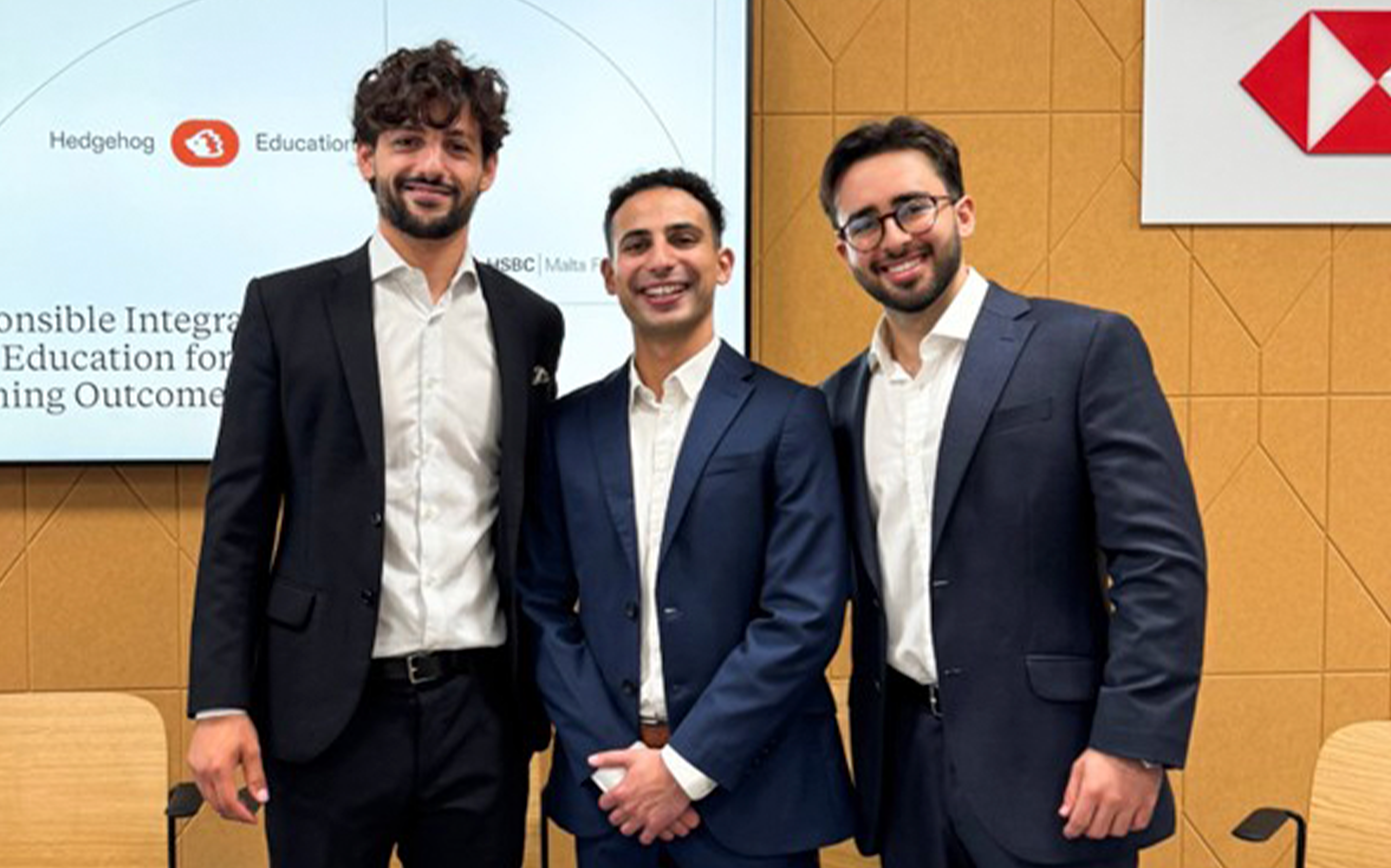
Founded in 2025, the Maltese startup is being built by a founding team consisting of Mikea Dimech, Miguel Micallef and Nigel Caruana, bringing together experience across artificial intelligence, education, policy and business.
The company publicly introduced its approach to the platform in July 2026, describing its first major focus as one of education’s oldest routines: homework.
AI Without Simply Giving Students The Answer
Hedgehog’s premise is straightforward.
A teacher can create an exercise from scratch or upload material already being used in class, including worksheets and past exam-style material.

Students then complete those exercises within Hedgehog’s online environment. Rather than being presented with an immediate solution, the platform is designed to guide them through the problem while keeping them responsible for reaching the answer themselves.
Once the work is completed, teachers can use a dashboard to see student performance and identify misconceptions or knowledge gaps requiring follow-up.
The company says it does not want AI to replace assessment, mentoring or a teacher’s professional judgement. It also says understanding, rather than simply producing grades or completing exercises, is the measure it wants the platform to focus on.
The Classroom Problem That Started Hedgehog
Part of the idea came directly from co-founder Miguel Micallef’s experience as a physics teacher.
According to Hedgehog, Micallef found himself correcting homework that appeared almost perfect, only to discover that some students struggled when asked to solve similar problems independently.
That experience helped shape the problem the company wanted to address: students being able to use general-purpose AI as a shortcut to an answer without necessarily understanding how to reach it.
Hedgehog describes this as a risk of “cognitive offloading” — shifting parts of the thinking process to technology rather than developing those skills independently.
Instead of attempting to remove AI from education entirely, the team’s approach is to design the technology around the learning process.
Three Different Backgrounds Behind The Startup
CEO Mikea Dimech leads Hedgehog’s strategy, product engineering and overall execution.
Before launching the company, Dimech worked as a Data and AI consultant in the UK on projects spanning financial services, retail and telecommunications. He holds an MSc in Artificial Intelligence from the University of St Andrews, where Hedgehog says he ranked first in his cohort and received the Faculty of Science University Medal. His university research included the use of AI in early breast cancer detection with 3D mammography.
His interest in the intersection between AI and education also predates Hedgehog. In 2023, Dimech publicly argued that education needed to adapt to generative AI while preserving critical thinking and the human role of teachers.
He also has history within Malta’s startup scene: the World Summit Awards listed Dimech among the producers behind the FreeHour Student App when it received a European Young Innovators award in 2019.
A Teacher Shaping The Educational Side
Micallef serves as Director of Education.
He has taught physics from secondary level through university and previously founded a tutoring organisation focused on O-Level and Intermediate Physics.
Alongside his teaching, he specialises in medical physics and radiation oncology and lectures on those subjects at the University of Malta at undergraduate and Master’s level.
At Hedgehog, his role focuses on pedagogy and developing the learning approach behind the platform using classroom experience and evidence from education research.
The company says the exercise system draws on concepts including inquiry-based learning and Socratic tutoring, with students receiving enough support to progress without simply being handed solutions.
Building The Business Side
Nigel Caruana, Hedgehog’s Director of Business Development, handles partnerships and the startup’s strategy for reaching secondary schools and universities.
Caruana is an economist with a Master’s degree from the London School of Economics and also works as a Policy Adviser at the Malta Business Bureau in Brussels.
His previous experience includes working as an economist at Brussels-based think tank ERCST and joining Maltese startup Huskie as its first non-founding team member.
His role at Hedgehog is focused on developing the commercial and partnership side of the company while keeping its expansion aligned with its educational aims.
Starting With Homework
For now, Hedgehog has deliberately chosen homework as its starting point.
The team argues that homework is one of the moments when students are most likely to become stuck without a teacher nearby — and therefore one of the moments when reaching for an AI-generated answer becomes particularly tempting.
Its proposed alternative is a personalised exercise environment capable of providing support while still requiring the student to work through the problem.
For teachers, the startup wants that same technology to provide faster insight into what students understand and where intervention may be needed, rather than waiting until worksheets have been manually corrected days later.
The company says it is currently working with schools interested in promoting critical and independent thinking, although it has not publicly named participating institutions or published figures on how many schools or students are using the platform.
A Maltese Answer To A Global Education Question
Hedgehog is entering a debate that schools, teachers and families around the world are already having: if students can ask AI for almost any answer, how should technology be used without weakening the skills education is supposed to develop?
The Maltese startup’s answer is not to reject AI.
Instead, its founders are betting that AI can be designed to challenge students, personalise support and give teachers useful information — while still leaving the actual thinking in human hands.
Whether that approach succeeds at scale will depend on how the platform performs in real classrooms, but the principle behind it is clear: technology should support the learning process rather than become a shortcut around it.