
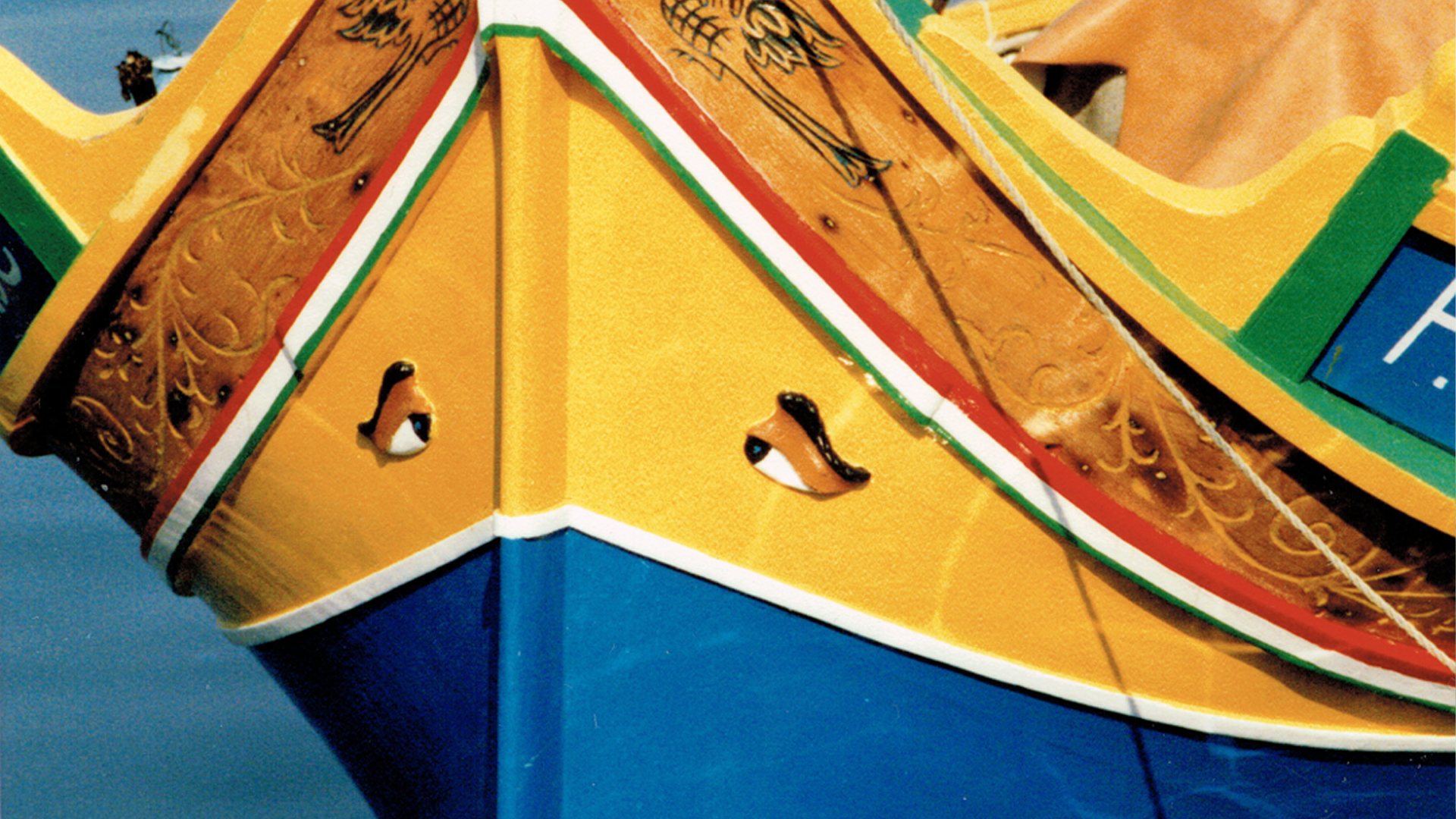
Look closely at a traditional Maltese luzzu and one detail seems to look straight back at you: a pair of eyes painted on either side of the bow.
Known commonly as the “Eyes of Osiris”, these distinctive symbols are traditionally associated with protection and the hope of keeping fishermen and their boats safe at sea.
More than decoration
The belief surrounding the eyes has been documented for more than a century.
Research into the tradition recounts how James Hornell, who visited Malta and Gozo in the early 1920s, recorded a belief that the eyes protected boats against the “evil eye”. In Gozo, he also encountered the idea that the eyes gave a vessel a spiritual identity, almost as though the boat itself were alive.
For fishing communities whose livelihoods depended on the sea, the symbolism carried a deeply human message: protection for the vessel and those aboard it.
An ancient Mediterranean symbol
Eyes on boats are not unique to Malta. Similar symbols appeared on ancient Egyptian vessels, while Greek and Roman boats also carried eyes.
Research published in Archaeonautica suggests Phoenician seafarers likely played a role in spreading the symbol around the Mediterranean.
That does not mean, however, that the eyes painted on Maltese boats today can be traced through one continuous tradition directly back to Phoenician Malta. Researchers note that eye symbols have appeared on boats in different parts of the world and may have had more than one point of origin.
Is the luzzu itself Phoenician?
The history of the painted eyes should also be separated from the history of the luzzu itself.
Maritime historian Joseph Muscat explains that the luzzu developed from the Italian gozzo and became one of Malta’s principal fishing boats during the early 20th century.
Muscat also cautions that there is little tangible evidence directly connecting Malta’s traditional boats with Phoenician vessels. The popular idea that today’s luzzu is essentially an unchanged Phoenician boat therefore goes further than the available evidence supports.
What remains is a distinctive piece of Malta’s maritime identity, combining craftsmanship with beliefs shaped by generations of life at sea.
Behind those familiar eyes is a simple hope that has mattered to seafarers for centuries: that the boat and everyone aboard it will return safely home.